

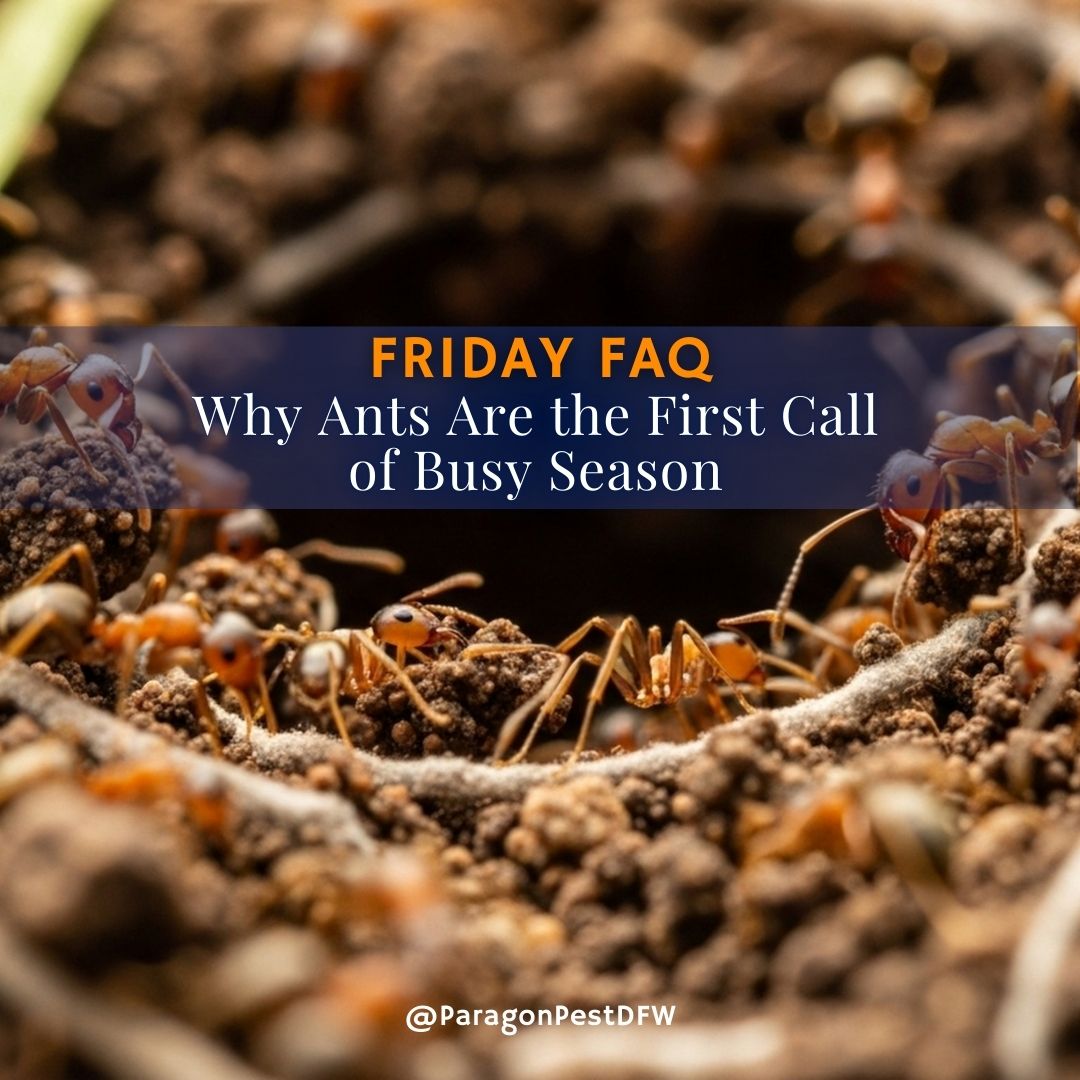
Friday FAQ: Why Ants Are the First Call of Busy Season
Every year in Dallas Fort Worth, we know busy season has started when the ant calls begin.
It usually happens right after the first real stretch of warm weather. Homeowners who haven’t seen a single pest all winter suddenly notice a thin line of ants along a backsplash or near a bathroom sink. It feels sudden, but it’s not random.
Here’s what’s actually happening.
What Happens Underground During Winter
Ant colonies don’t disappear when it gets cold. They shift.
During winter, most ant species in North Texas move deeper into the soil where temperatures stay more stable. Activity slows down, but the colony remains intact. The queen survives. Workers stay clustered. They are simply conserving energy.
As soil temperatures warm in late winter and early spring, those colonies move back toward the surface. They are ready to start foraging again almost immediately.
That’s why ants are often the first visible pest of the season.
Why Ants Start Moving Before Other Pests
Unlike mosquitoes or other insects that need standing water or longer breeding cycles, ant colonies already exist and are established. They don’t need to build numbers from scratch.
As soon as conditions are right, workers head out to search for food and moisture. And because our homes provide both, they often end up inside.
In the pest control industry, a steady increase in ant calls is one of the earliest indicators that seasonal demand is about to ramp up.
How One Scout Turns Into a Full Trail
One of the most common questions we hear is, “Why did they show up overnight?”
Usually, it starts with a single scout ant. That scout is searching for food or water. If it finds something worth reporting back, it returns to the colony while laying down a pheromone trail.
That trail becomes a roadmap.
Within hours, more workers follow the same path. What began as one ant can quickly turn into a visible line moving across a countertop or along a baseboard.
Spraying the ants you see may make the trail disappear temporarily, but it does not address the colony itself. As long as the source and entry point remain, activity continues.
Why Waiting Makes It Worse
Early in the season, colonies are expanding. The queen increases egg production as temperatures stabilize, and worker numbers grow quickly.
If ants are consistently finding food or moisture inside your home, the colony adapts. Trails become more established. In some cases, satellite colonies can form closer to the structure, especially in soil around slab foundations.
The earlier the activity is addressed, the easier it is to prevent larger infestations later in the summer.
Ant Season Is a Signal
When ants show up, they’re not just a nuisance. They’re usually the first sign that pest season in North Texas has officially started.
Paying attention early can help prevent bigger issues as temperatures continue to rise.
If you’re seeing early ant activity, a professional inspection can help determine where they’re entering and what steps will keep them from returning.
Busy season may start with ants, but it doesn’t have to turn into a bigger problem.