

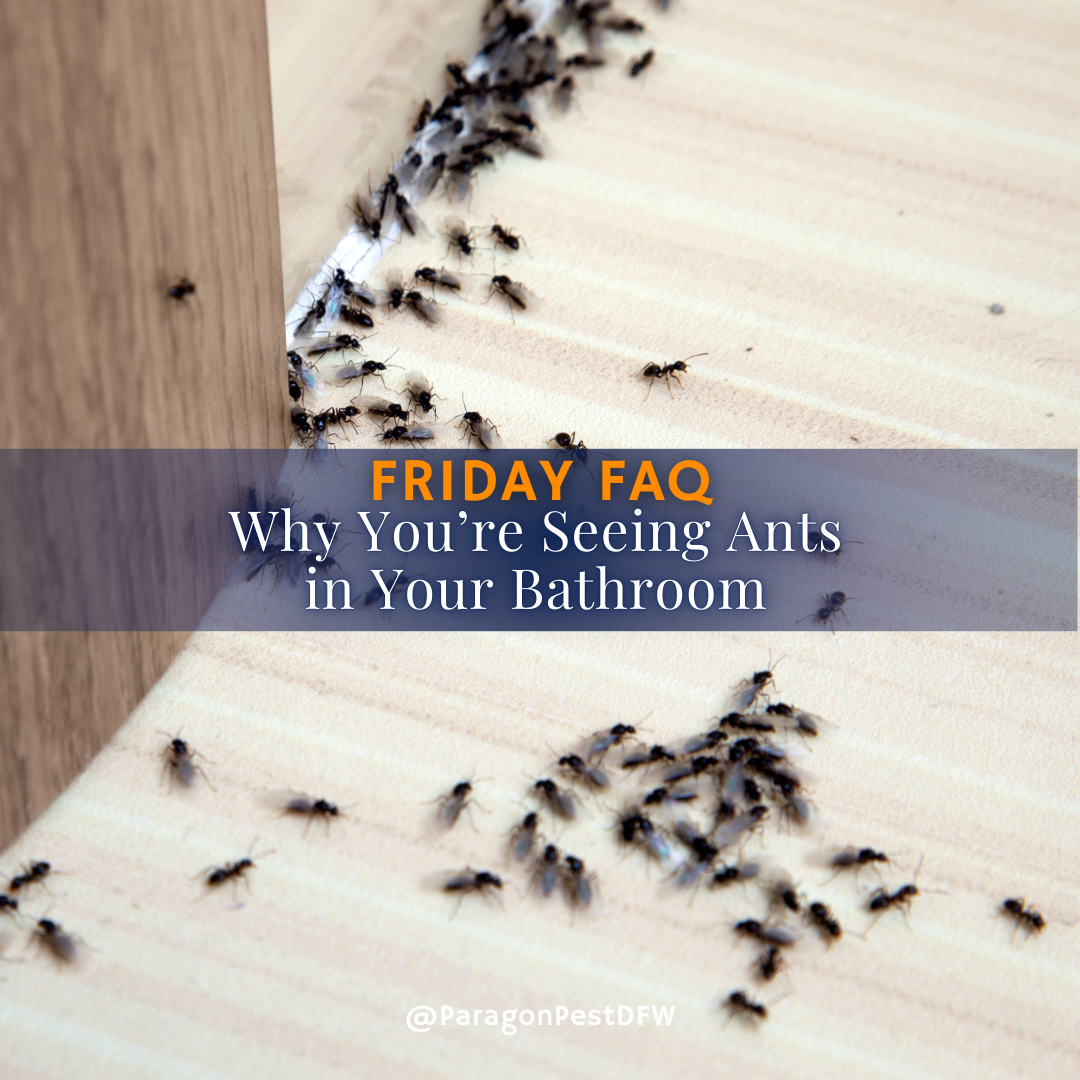
Why You’re Seeing Ants in Your Bathroom
Finding ants in the bathroom can feel especially strange. There’s no food on the counter, no crumbs on the floor, and nothing that would obviously attract them. Yet somehow, they keep showing up near the sink, along the baseboard, or around the tub.
In many Dallas Fort Worth homes, bathroom ant activity has very little to do with food. Instead, it usually comes down to moisture, hidden structural access, and seasonal environmental shifts that push ants indoors.
Understanding why they are there makes it much easier to stop the problem at its source.
Moisture Driven Foraging
Ants do not search only for food. They also actively search for water.
When outdoor conditions become dry, especially during late summer in North Texas, ant colonies begin looking for consistent moisture sources. Bathrooms provide exactly that. Steam from showers, condensation around pipes, and even minor plumbing leaks can create small but reliable water sources.
Even if everything appears dry on the surface, humidity trapped beneath a vanity or behind a baseboard can be enough to attract foraging ants. If you notice activity near sink edges, grout lines, or toilet bases, there is a good chance they are responding to moisture rather than anything edible.
Access Through Wall Voids
Bathrooms are often located along exterior walls or adjacent to plumbing lines that run through multiple rooms. Inside those walls are open spaces known as wall voids. These voids allow ants to travel unseen from the outside foundation into interior areas.
A colony may be nesting outside near the slab or landscaping, and the ants are simply using structural gaps to move inside. In some cases, certain ant species may even establish nests within wall cavities themselves.
You may only see a small number of ants at a time, but that does not always reflect the size of the colony. The majority of activity can remain hidden behind drywall, emerging only where small openings exist around pipes, caulking, or trim.
Foundation Plumbing Penetrations
Every home has plumbing lines that enter through the foundation or slab. Over time, tiny gaps can develop around those penetrations. These spaces are often too small to notice during a routine inspection, but they are more than large enough for ants.
Once ants discover a gap around a pipe or beneath a cabinet, it becomes a consistent entry point. In slab homes especially, ants can travel beneath the structure and emerge directly around bathroom plumbing fixtures.
If you continue to see ants in the same location despite cleaning, it usually indicates a structural access point rather than surface attraction.
Why Activity Spikes During Seasonal Changes
Seasonal transitions are one of the biggest triggers for indoor ant movement.
In the spring, colonies expand rapidly as temperatures rise. In late summer and early fall, drought conditions drive ants to search for moisture inside homes. After periods of heavy rain followed by sudden heat, soil conditions can shift enough to disturb underground nests, causing increased foraging behavior.
In Dallas Fort Worth, these seasonal patterns often explain why bathroom ant sightings seem to appear suddenly. The ants were likely already nearby. Environmental pressure simply changed their behavior.
What Actually Solves the Problem
Wiping away visible ants or using over the counter sprays may temporarily reduce activity, but it rarely addresses the underlying cause.
Long term control typically involves identifying the species, locating the colony, treating the exterior foundation properly, and sealing structural entry points. In some cases, correcting minor moisture issues also plays an important role.
Ants in the bathroom are not random. They are responding to access and environmental conditions.
If you are noticing repeat activity in your Dallas Fort Worth home, a professional inspection can help determine exactly where they are entering and why. Once the source is identified, the solution becomes much more straightforward.