

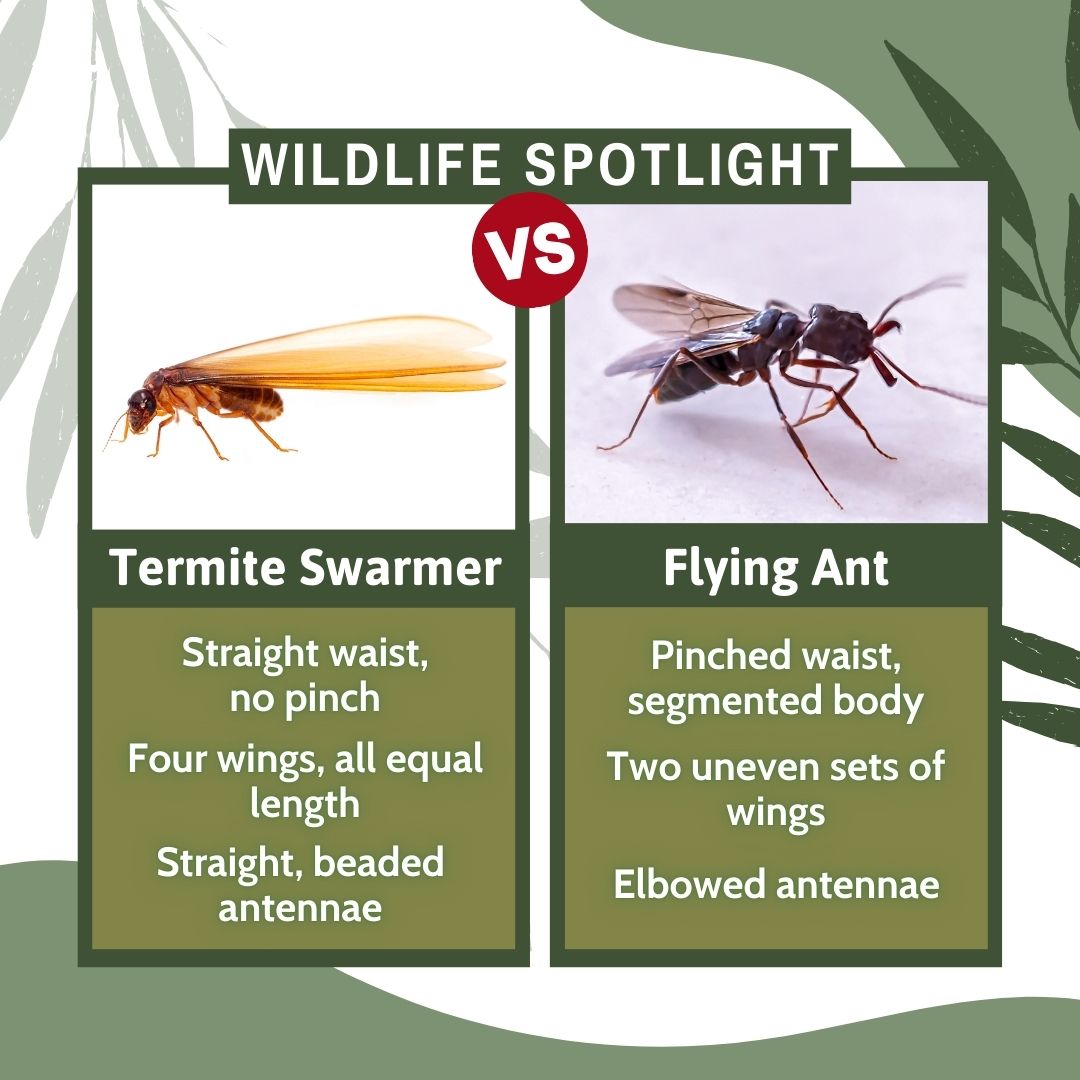
Wildlife Wednesday: Termite Swarmers vs. Flying Ants
Every spring in the Dallas-Fort Worth area, homeowners start noticing winged insects around their windows, doors, or light fixtures. The most common reaction is to assume they're flying ants and move on. Sometimes that's right. But if what you're seeing is actually termite swarmers, the distinction matters quite a bit.
Termite swarmers and flying ants look remarkably similar at first glance, which is exactly why so many infestations go unaddressed longer than they should. This week's Wildlife Wednesday breaks down how to tell them apart and what to do once you know which one you have.
What Swarming Actually Means
Both termites and ants produce winged reproductives that leave the colony in large numbers to mate and start new colonies. This event is called a swarm, and it typically happens in warm weather after rain in the spring. The swarmers themselves are not the ones causing damage. Their job is reproduction, and most of them don't survive long. What a swarm signals, though, is that an established colony is nearby.
For termites, that nearby colony is the concern. Subterranean termites, which are the most common species in North Texas, build their colonies underground and travel up through soil and mud tubes to reach wood. A swarm near or inside your home is a reliable sign that a colony has been active in the area long enough to produce reproductives.
How to Tell Them Apart
The three most reliable differences are the waist, the wings, and the antennae.
Termite swarmers have a straight, thick waist with no visible pinch between the thorax and abdomen. Their two pairs of wings are equal in length and extend well past the body. Their antennae are straight and slightly beaded in appearance.
Flying ants have a clearly pinched, segmented waist that is one of the easiest identifiers at a glance. Their wings are unequal in size, with the front pair noticeably larger than the rear. Their antennae are elbowed, bending at a distinct angle.
If you've found shed wings, that can also help. Termite swarmers shed their wings quickly after landing, and the wings are nearly identical in size. Ant wings are less uniform and less commonly found shed in the same way.
Why the Difference Matters
Flying ants inside the home are worth addressing, but they don't carry the same structural implications as termites. A flying ant problem usually traces back to a moisture issue or a nest nearby. It's manageable and doesn't put your home's structure at risk.
Termite swarmers inside the home are a stronger signal. It doesn't automatically mean your home has severe damage, but it does mean an inspection is worth doing sooner rather than later. Termites can work inside walls, floor joists, and framing for years before the damage becomes visible from the surface.
What to Do If You're Not Sure
The easiest first step is to catch one if you can and take a close look at the waist and wings. A photo works too. If you send it our way, we're happy to help identify it.
If you're seeing swarmers inside the home, near a window sill, or around a foundation, it's worth having an inspection done regardless of which species it turns out to be. Our Trench and Treat service starts with a free termite inspection and zero obligation. We'll assess the property, check for signs of activity or damage, and give you an honest picture of what's going on before any treatment is discussed. Better to know early.